President Tinubu Signs Electoral Act 2026 into Law, Emphasizing Protection from Hackers Ahead of 2027 Elections
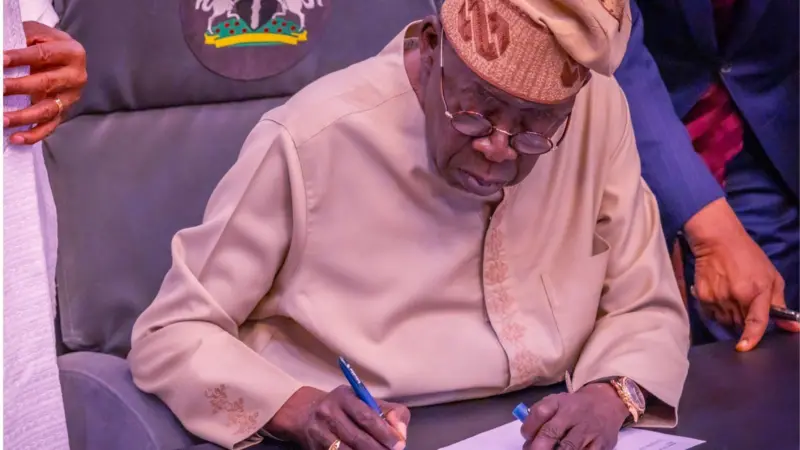
President Tinubu Assents to Electoral Act 2026
President Bola Tinubu has signed the Electoral Act, 2022 (Repeal and Re-Enactment) Bill 2026 into law. The signing took place on Wednesday at the State House in the presence of top government officials, including Senate President Godswill Akpabio, Speaker of the House of Representatives Tajudeen Abbas, and Chief of Staff to the President Femi Gbajabiamila.
The new law will regulate the conduct of federal, state, and Area Council elections in the Federal Capital Territory, Abuja, and related matters. President Tinubu stated that the amendments are not about politics but about process, closing gaps, strengthening procedures, and providing greater clarity for those conducting and participating in elections.
Tinubu’s Remarks on Election Integrity and Technology
In a statement posted on X after assenting to the bill, President Tinubu emphasized the need to protect elections from hackers, saying, ‘We no fit expose our election to hackers.’ He stressed that the essence of democracy is solid discussions committed to national development and nation-building, essential for the nation’s stability.
Addressing concerns over the transmission of election results, the President, as quoted by Channels TV, remarked, ‘In fact, for di final results, no be computer you go follow tok; na pipo wey go announce di final results you go follow tok.’ He questioned Nigeria’s broadband capabilities, asking how technically prepared the country is today and tomorrow for real-time transmission.
Tinubu clarified that as long as voters show up personally at polling booths, electoral officers will issue ballot papers manually, votes will be cast, sorted, and counted manually. He added that citizens must walk to polling units with confidence, and declared results must be trusted, a confidence that does not happen by chance.
Legislative Journey of the Amendment Bill
Both chambers of the National Assembly passed the amendment bill on Tuesday, 17 February, following weeks of legislative consideration and public engagement on key electoral reforms. The assent came amid national debates on electronic transmission of election results, a contentious aspect that generated significant reactions.
Lawmakers passed a harmonised version allowing manual and electronic transmission of results from polling units to the INEC Result Viewing (IREV) portal, as in Form EC8A. However, they rejected a proposed amendment to Clause 60, Subsection 3, which would have made electronic transmission compulsory for INEC presiding officers after signing and stamping Form EC8A and obtaining candidates’ countersignatures.
Instead, the Senate adopted the existing provision stating that ‘di presiding officer shall transfer di results, wey include di total number of accredited voters and di results of di ballot, for manner as prescribed by di Commission.’ This decision sparked widespread reactions, including protests at the National Assembly demanding compulsory electronic transmission.
Civil society groups and opposition figures had long pushed for real-time transmission to polling units to INEC’s central server, arguing it would reduce electoral malpractices and enhance credibility. Due to differing versions passed by the House of Representatives and the Senate, a Joint Senate and House Conference Committee was established to harmonise positions. During an emergency session on Tuesday, both houses agreed and passed the harmonised version.
Key Reforms in the Signed Electoral Act 2026
The new law introduces several major changes aimed at strengthening transparency, improving logistics, and addressing operational lapses observed in previous elections. These include:
- Voter registration: Required documents narrowed to three – birth certificate, Nigerian passport, and National Identification Number (NIN).
- Downloadable voter cards: Voters can download their voter cards from the INEC website.
- Electronic transmission of results: Electronic transmission to IREV is compulsory, but if it fails due to network issues, the physical result sheet (Form EC8A) becomes the primary source for collation and declaration.
- Mode of party primaries: Direct primaries and consensus are the only methods for political parties to nominate candidates, eliminating indirect primaries.
- Disbursement of funds to INEC: Government must release election funds to INEC at least six months before the general election, reduced from 12 months previously.
- Deadline for submission of candidates’ lists: Political parties must submit candidate names 120 days before election day, shortened from 180 days.
- INEC’s final list of candidates: The electoral body must publish the list 60 days before the election, down from 150 days.
These adjustments are expected to streamline processes and build greater trust in the electoral system ahead of the 2027 elections.
Context of National Debate and Public Expectations
The amendments address ongoing concerns from past elections, particularly around technology and result transmission. The provision for electronic transmission with a fallback to manual processes reflects a balance between innovation and practicality, given debates on Nigeria’s technical readiness.
President Tinubu’s signing underscores a commitment to procedural integrity, ensuring that manual verification remains central while leveraging technology where feasible. The presence of legislative leaders at the ceremony highlights bipartisan support for the reforms.
As Nigeria prepares for future polls, the Electoral Act 2026 positions the Independent National Electoral Commission (INEC) with clearer guidelines on voter accreditation, result handling, and funding timelines. Political parties will adapt to the new primary modes, potentially altering nomination dynamics.
The law’s emphasis on manual counting and physical forms in case of failures aims to safeguard against vulnerabilities like hacking, aligning with the President’s call to protect the democratic process. This development marks a pivotal step in refining Nigeria’s electoral framework for enhanced credibility and efficiency.